


RSS Global News Platform

    • Global liquidity is the macro signal most Bitcoin investors overlook — so I built an app for it May 29, 2026
      Most Bitcoin investors watch price. Few watch what drives it. Global liquidity — M2, Fed balance sheet, Reverse Repo, TGA, credit spreads — has historically led Bitcoin by weeks to months. When liquidity expands, Bitcoin tends to follow. When it contracts, Bitcoin feels it first. I built LiquidityPulse to track exactly this. It combines these […]
    • A question for understanding bitcoin and the blockchain. May 29, 2026
      My understanding is that each coin contains the data that is contained in the chain leading up to it? I think? My question is. Hypothetically speaking, if you somehow ended up today, with a USB containing a BTC wallet with a single coin mined in 2030. Could you recreate it to quickly advance the chain? […]
    • BitGo BTC Wallet... Gone? May 29, 2026
      EDIT: This is a UI issue apparently - my old V1 wallet is not showing up in the new UI. Will experiment and post back with results. G'day team, hoping you folks can give me some guidance here. I've raised a ticket with the BitGo team but no response yet. Logged into BitGo today to […]
    • Retail is fleeing for the exits, but I’m actually thanking the ETFs for this 73k dip May 29, 2026
      While the "Sell in May" sentiment takes over, the ETFs and whales are quietly absorbing the supply. I’m breaking down the dark pool activity and why this current volatility is a gift, not a warning. submitted by /u/MCL-Jonathan [link] [comments]
    • Best crypto card in 2026 for actually using my holdings? May 29, 2026
      I’ve been holding crypto since 2021, mostly BTC, but honestly I’m getting tired of just letting it sit there. Every time I want to actually use it, it feels like a whole process. Move funds to an exchange, convert to fiat, deal with fees, wait for withdrawals, then finally spend it. At that point it […]
    • Is chatBTC actually real or just a broken ghost town? May 29, 2026
      Hey guys, has anyone actually successfully used chatBTC? Every single time I try to ask it a question, it just spits out some generic message along the lines of "I can't answer this question." It’s a bit laughable considering what they claim it’s supposed to do. Is anyone else getting blocked by this? Is there […]
    • Daily Discussion, May 29, 2026 May 29, 2026
      Please utilize this sticky thread for all general Bitcoin discussions! If you see posts on the front page or /r/Bitcoin/new which are better suited for this daily discussion thread, please help out by directing the OP to this thread instead. Thank you! If you don't get an answer to your question, you can try phrasing […]
    • Mining plan for free electricity May 29, 2026
      My solar panels create more electricity than I can use, what is a good suggestion for a setup for mining when electricity is free? submitted by /u/bradwwww [link] [comments]
    • Would you use a Bitcoin multisig vault where the company can't see your data? May 29, 2026
      I'm building a collaborative-custody 2 of 3 multisig Bitcoin vault and want to test the waters to see if anyone would be interested. Privacy is the whole point. Encryption happens on your device, the keys never leave it, and our servers only ever see ciphertext. We couldn't read your data if we wanted to. It's […]
    • Using Bitcoin in Canada without Capital Gains May 28, 2026
      Good afternoon everyone, I have an interesting question that I have been wrestling with over and over. How do I use Bitcoin in Canada without running into issues with Capital Gains taking a portion of my earnings. My struggle is that according to the capital gains laws, an purchase of goods or services with an […]
    • Anonymous Plaintiff Seeks Legal Title To $293 Billion In Dormant Bitcoin, Without Holding Any Private Keys May 28, 2026
      A pseudonymous claimant, “Noah Doe,” alongside two Wyoming LLCs, has filed a lawsuit in New York Supreme Court seeking recognition as the rightful owner of 39,069 dormant Bitcoin addresses containing roughly 3.8 million BTC—valued at about $293 billion. submitted by /u/TheresNoSecondBest [link] [comments]
    • May 28, 2026 Best Miner May 28, 2026
      As products are out and aging, where does everyone stand on a product that has help up over time and they would recommend? Trying to gather data and any input helps. submitted by /u/mushdude [link] [comments]
    • Exit 6 ₿oss Market & Kitchen May 28, 2026
      From abandoned drive-thru to community destination. ₿oss Market & Kitchen is slowly coming to life at Exit 6 in Chester, PA. ✅ Windows repaired ✅ Cleanup underway ✅ Kitchen restoration started ✅ Outdoor market planning ✅ Bitcoin accepted from day one The vision: Drive-thru food Outdoor produce market Bitcoin education Community events Real-world Bitcoin usage […]
    • Built p2psats — alerts for NIP-69 P2P trade orders across Nostr May 28, 2026
      The P2P bitcoin market today is fragmented across siloed platforms. Robosats users only see Robosats offers. lnp2pbot users only see lnp2pbot offers. Mostro the same. That fragmentation costs both sides real money: you need fiat in a hurry, post a sell order at a discount on your platform of choice, and hear crickets, even though […]
    • Our lightning L402 has 1,185 services. Most developers building Lightning apps have no idea they exist or how to find the reliable ones. May 28, 2026
      L402 is the protocol that lets an HTTP server require a Lightning payment before returning data. An app sends a request, gets back a 402 with a Lightning invoice, pays it, retries, gets the data. No accounts, no subscriptions, no OAuth. Just a payment and a response. The problem is there's no good way to […]
    • Why people are trading headlines, not structure? May 28, 2026
      One thing I started noticing this year -most people react to price more than it should be, the real shift usually starts earlier in positioning, volatility and sentiment. When btc went above 80k a lot of twitter influencers suddenly became aggressively bullish again. At the same time, some of the underlying risk signals actually became […]
    • The strongest argument against Bitcoin would be a fiat system that actually worked May 28, 2026
      Most Bitcoin discussions start from the assumption that fiat currencies are fundamentally broken. But let us stop and steelman fiat, for once. A well-functioning fiat system has real advantages. Centralized monetary systems are more resource-efficient, easier to coordinate, and can respond quickly during crises. In theory, they can provide stable purchasing power, fast payments, financial […]
    • I ran Bitcoin miners for two years. Here's what it actually taught me. May 28, 2026
      Started in 2023. Bought ASICs thinking I'd build a side income for my family. Ended up with 9 ASICs and 3 GPU rigs running in my basement. Sounded like a beehive down there. Eventually moved to immersion cooling just to keep the peace at home. Something happened while i was trying to make the operation […]
    • 12 words is your wallet. Here is how serious people back them up. May 28, 2026
      Your seed phrase is your wallet. Wallet software, hardware device, list of addresses, transaction history: all derivable from the seed. Lose the words, lose every key, lose every bitcoin those keys ever controlled. Three threats sit on every Bitcoin backup: theft, loss, coercion. The hard part is that defending one often weakens defense against the […]
    • Kraken Launches Bitcoin Vault With up to 2.5% Annual Yield May 28, 2026
      submitted by /u/EvelynClede [link] [comments]

What is cryptocurrency

What is cryptocurrency:  21st-century unicorn – or the money of the future?

This introduction explains the most important thing about cryptocurrencies. After you‘ve read it, you‘ll know more about it than most other humans.

Today cryptocurrencies have become a global phenomenon known to most people. While still somehow geeky and not understood by most people, banks, governments and many companies are aware of its importance.

In 2016, you‘ll have a hard time finding a major bank, a big accounting firm, a prominent software company or a government that did not research cryptocurrencies, publish a paper about it or start a so-called blockchain-project.

But beyond the noise and the press releases the overwhelming majority of people – even bankers, consultants, scientists, and developers – have a very limited knowledge about cryptocurrencies. They often fail to even understand the basic concepts.

So let‘s walk through the whole story. What are cryptocurrencies?

  • Where did cryptocurrency originate?
  • Why should you learn about cryptocurrency?
  • And what do you need to know about cryptocurrency?

What is cryptocurrency and how cryptocurrencies emerged as a side product of digital cash

Few people know, but cryptocurrencies emerged as a side product of another invention. Satoshi Nakamoto, the unknown inventor of Bitcoin, the first and still most important cryptocurrency, never intended to invent a currency.

In his announcement of Bitcoin in late 2008, Satoshi said he developed “A Peer-to-Peer Electronic Cash System.“

His goal was to invent something; many people failed to create before digital cash.

After seeing all the centralized attempts fail, Satoshi tried to build a digital cash system without a central entity. Like a Peer-to-Peer network for file sharing.

This decision became the birth of cryptocurrency. They are the missing piece Satoshi found to realize digital cash. The reason why is a bit technical and complex, but if you get it, you‘ll know more about cryptocurrencies than most people do. So, let‘s try to make it as easy as possible:

To realize digital cash you need a payment network with accounts, balances, and transaction. That‘s easy to understand. One major problem every payment network has to solve is to prevent the so-called double spending: to prevent that one entity spends the same amount twice. Usually, this is done by a central server who keeps record about the balances.

In a decentralized network, you don‘t have this server. So you need every single entity of the network to do this job. Every peer in the network needs to have a list with all transactions to check if future transactions are valid or an attempt to double spend.

But how can these entities keep a consensus about this records?

If the peers of the network disagree about only one single, minor balance, everything is broken. They need an absolute consensus. Usually, you take, again, a central authority to declare the correct state of balances. But how can you achieve consensus without a central authority?

Nobody did know until Satoshi emerged out of nowhere. In fact, nobody believed it was even possible.

Satoshi proved it was. His major innovation was to achieve consensus without a central authority. Cryptocurrencies are a part of this solution – the part that made the solution thrilling, fascinating and helped it to roll over the world.


The transaction is known almost immediately by the whole network. But only after a specific amount of time it gets confirmed.

Confirmation is a critical concept in cryptocurrencies. You could say that cryptocurrencies are all about confirmation.

As long as a transaction is unconfirmed, it is pending and can be forged. When a transaction is confirmed, it is set in stone. It is no longer forgeable, it can‘t be reversed, it is part of an immutable record of historical transactions: of the so-called blockchain.

Only miners can confirm transactions. This is their job in a cryptocurrency-network. They take transactions, stamp them as legit and spread them in the network. After a transaction is confirmed by a miner, every node has to add it to its database. It has become part of the blockchain.

For this job, the miners get rewarded with a token of the cryptocurrency, for example with Bitcoins. Since the miner‘s activity is the single most important part of cryptocurrency-system we should stay for a moment and take a deeper look on it.

What are miners doing?

Principally everybody can be a miner. Since a decentralized network has no authority to delegate this task, a cryptocurrency needs some kind of mechanism to prevent one ruling party from abusing it. Imagine someone creates thousands of peers and spreads forged transactions. The system would break immediately.

So, Satoshi set the rule that the miners need to invest some work of their computers to qualify for this task. In fact, they have to find a hash – a product of a cryptographic function – that connects the new block with its predecessor. This is called the Proof-of-Work. In Bitcoin, it is based on the SHA 256 Hash algorithm.
 

What is Cryptocurrency


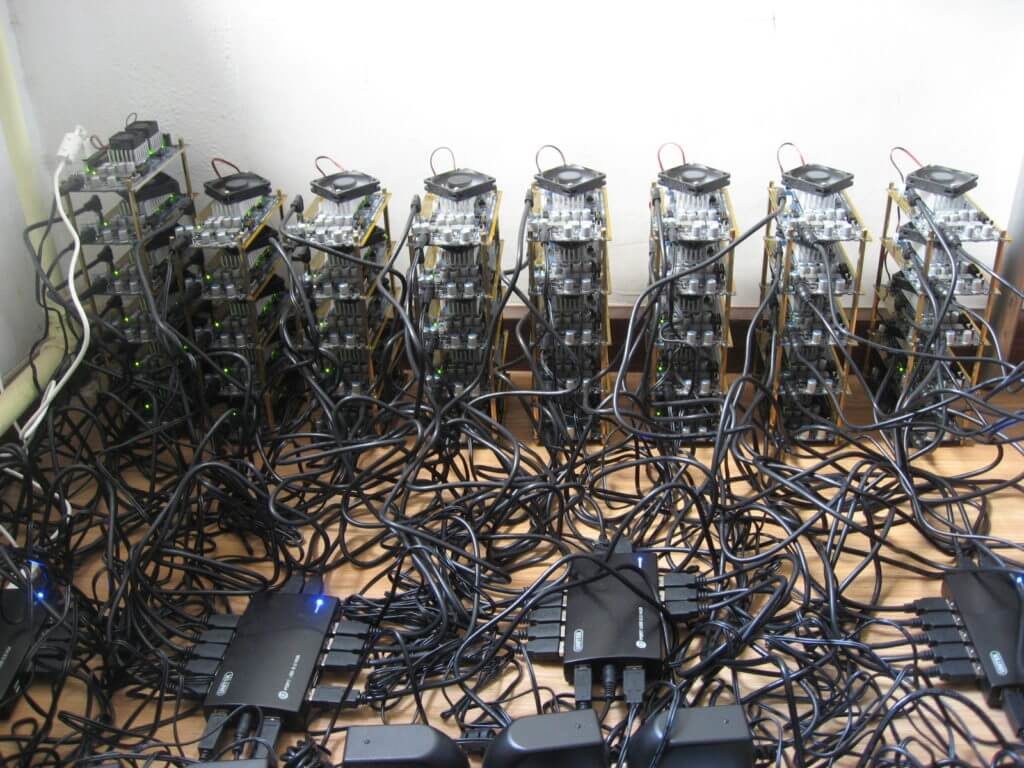
You don‘t need to understand details about SHA 256. It‘s only important you know that it can be the basis of a cryptologic puzzle the miners compete to solve. After finding a solution, a miner can build a block and add it to the blockchain. As an incentive, he has the right to add a so-called coinbase transaction that gives him a specific number of Bitcoins. This is the only way to create valid Bitcoins.

Bitcoins can only be created if miners solve a cryptographic puzzle. Since the difficulty of this puzzle increases the amount of computer power the whole miner’s invest, there is only a specific amount of cryptocurrency token that can be created in a given amount of time. This is part of the consensus no peer in the network can break.

Sidebar